
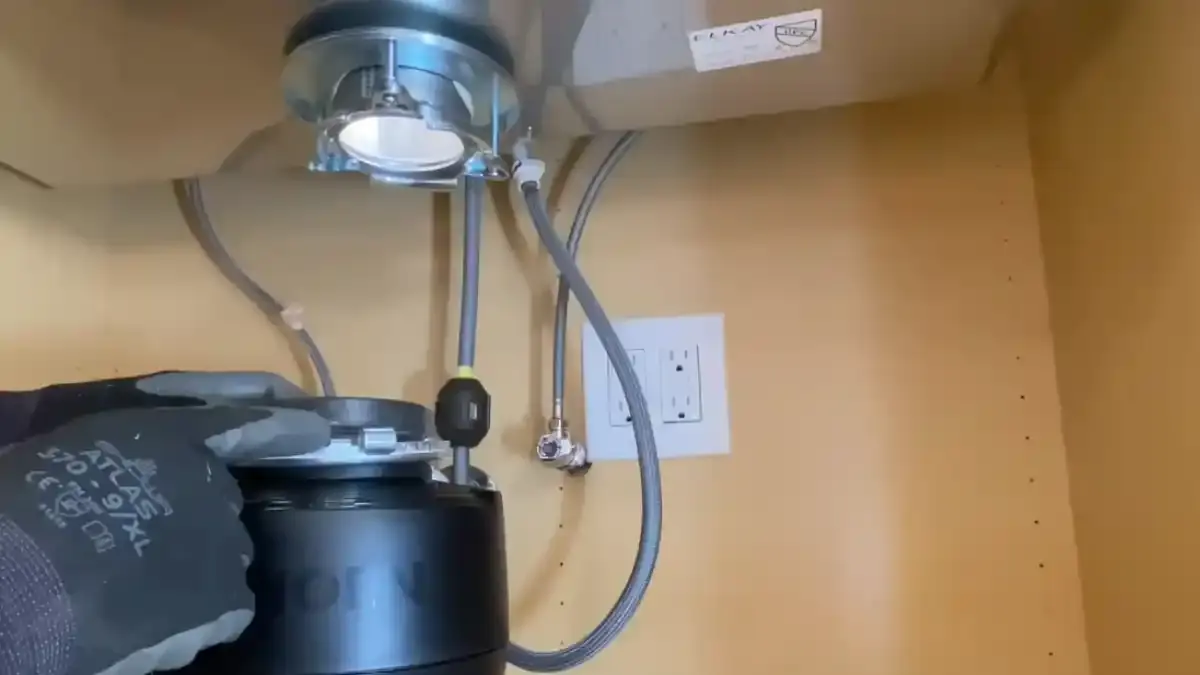
How the parts connect
Both sink bowls have a strainer and a tailpiece. One tailpiece drops into the disposal, which bolts to the sink flange of the first bowl. The disposal's discharge elbow sends water sideways to a tee. The second bowl's tailpiece connects to that same tee through a short horizontal pipe.
From the tee, one pipe goes to the trap and then to the wall. The dishwasher hose joins the disposal at a small inlet near the top. A knockout plug inside that inlet must be removed on a new unit, or the dishwasher cannot drain.
Forgetting this is the most common reason a new disposal install floods the dishwasher.
The slope and height details
| Mistake | What happens | Fix |
|---|---|---|
| Dishwasher knockout not removed | Dishwasher will not drain | Remove the plug from inside |
| No high loop on the dishwasher hose | Dirty water can flow back | Raise the hose under the counter |
| Second bowl pipe sloped the wrong way | Slow draining, standing water | Re-pitch the pipe toward the tee |
| Trap too far from the tee | Gurgling, odor | Shorten the run and add proper venting |
| Loose mounting ring | Leak at the flange | Re-seat and tighten the ring |
| Overlong horizontal run | Clogs and slow draining | Shorten or re-route the run |
| A horizontal run between the two bowls should slope slightly toward the tee. Too flat and water sits in the pipe. Too steep and the water outruns the solids. The usual guide is a gentle slope, and a plumber checks it with a level. |
Picking a disposal for a double sink
A continuous feed unit suits most kitchens. A batch feed unit needs a lid turned to run, and it is a good choice with children in the house. Horsepower matters for a busy kitchen. A larger motor handles tougher scraps and jams less often. Ask about noise insulation and a stainless steel grinding chamber. Check the mounting style.
Different brands use different flange and mounting ring designs, so a replacement may not fit the old flange without parts. Bring the model number if you are replacing a unit.
Electrical and safety
A disposal needs power from a switched outlet or a hardwired connection. A plug-in cord is easier to replace, and a hardwired unit requires an electrician or a licensed plumber who is allowed to do the wiring. Never reach into a disposal that has power. Turn the switch off and unplug it or flip the breaker first.
Do not use chemical drain cleaners in a sink with a disposal. They can damage seals and splash back on you. A drain snake or a plumber's tool is a safer choice.
Where to check permits and who may do the work in Glendale Heights
The Village of Glendale Heights publishes brochures that send residents to the Department of Community Development at (630) 260-6030 for permit questions. Its water heater brochure, for example, says plumbers doing contracted work must be registered and bonded with the Village.
A disposal swap is a small job, but any work that changes drain piping or adds electrical wiring can trigger permit or inspection questions.
The Illinois Department of Public Health licenses plumbers under the Illinois Plumbing License Law and lists the Illinois Plumbing Code under Title 77 of the Illinois Administrative Code. A call to Community Development before a larger kitchen remodel is the simplest way to learn what applies at your address.
Troubleshooting the usual problems
If the dishwasher will not drain after a disposal install, check the knockout plug first. If the sink drains slowly on one side, check the pipe slope and look for a clog in the tee. If you smell sewage, the trap may be dry or the vent may be blocked.
If water leaks at the flange, the mounting ring may be loose or the putty seal may have failed. A leak under the sink is usually a loose slip nut, and tightening it by hand often fixes it. If water keeps appearing, shut the stop valves and the water to the dishwasher and call a plumber.
Wet cabinet floors swell fast.
What to keep out of the disposal
Grease, coffee grounds in large amounts, pasta, rice, bones and fibrous vegetable scraps cause the clogs we see most. Run cold water before, during and after use. A disposal is not a trash can, and a jam usually means something hard or stringy went in.
If the sink backs up even with a working disposal, the clog may be past the tee. Our drain cleaning team clears kitchen branches, and a garbage disposal repair and installation visit covers the unit itself.
Hard water and the disposal
Moderately hard water leaves scale on the sink flange and the faucet. The DuPage Water Commission describes its supply as about 8 grains per gallon. Scale does not usually harm a disposal, but it can leave a crust on the flange and stiffen the faucet, and a faucet repair may come up at the same time.
Neighbors with the same layout
Kitchens in Bloomingdale and Wheaton often have the same two-bowl sink and the same dishwasher hookup. The advice here applies to them too.
When to call a plumber
Call a plumber if the unit is hardwired and you are not set up for that work. Call too if the sink cutout does not match the new flange, if the drain pipe is old galvanized steel or if you find a leak you cannot trace. A short visit saves a cabinet floor.
Double sink disposal questions
The disposal mounts under one bowl, and the second bowl's tailpiece joins the disposal's outlet at a tee before the trap.
The knockout plug in the dishwasher inlet may not have been removed. Remove it from inside the inlet.
It is a raised section of the dishwasher drain hose that stops dirty water from flowing back into the dishwasher.
We advise against it. It can damage seals and splash back when you open the trap.
Call Community Development at (630) 260-6030. Larger kitchen work may involve permits, and plumbers doing contracted work must be registered and bonded with the Village.
A licensed plumber or electrician should handle hardwired connections.