
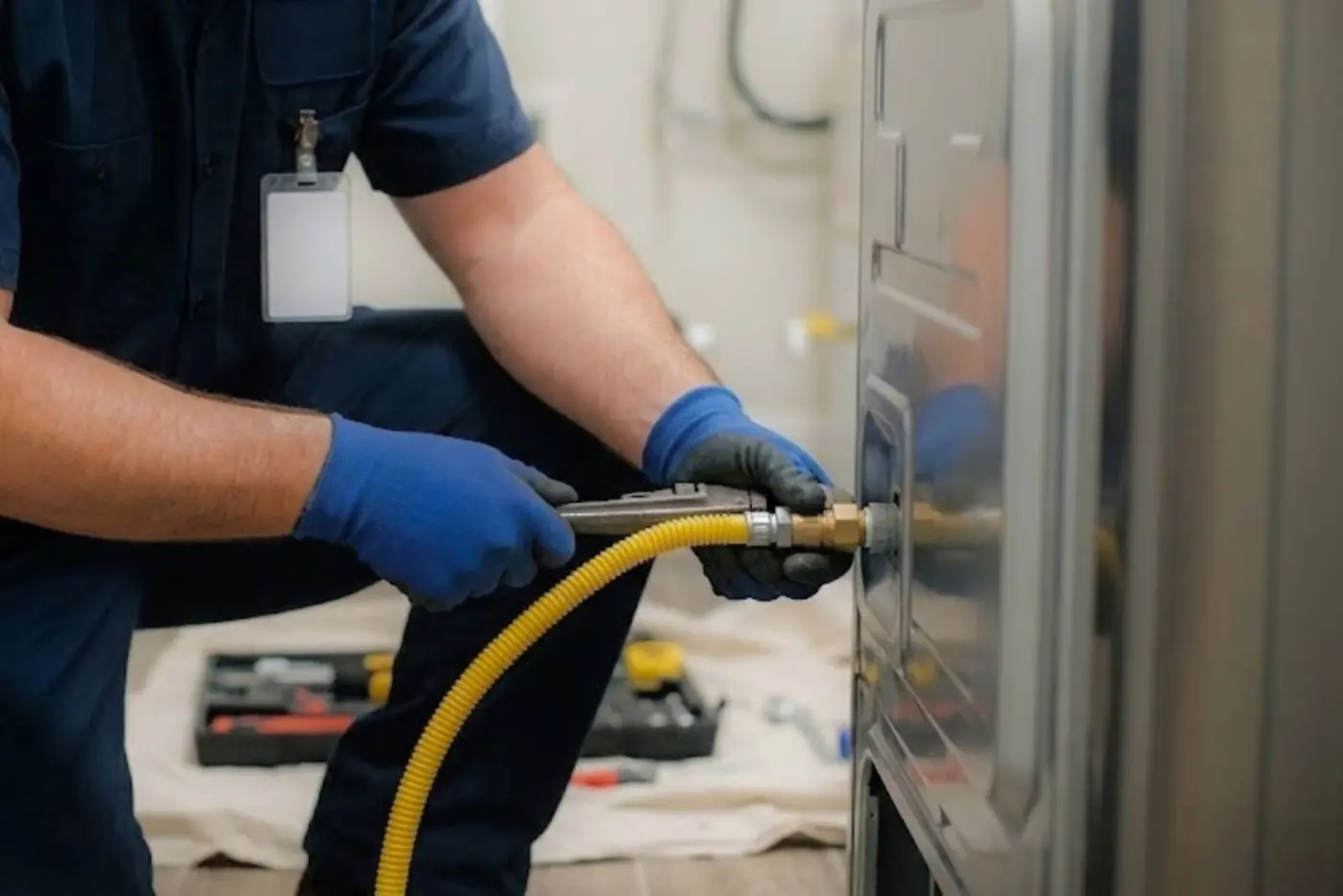
Why tankless heaters need more gas
A tank heater heats water slowly and holds it hot. Its burner runs a modest rate for a long time. A tankless unit heats water instantly as it flows, so its burner must fire at a high rate while a tap is open.
The unit's rated input, measured in thousands of BTU per hour, is far higher than a tank's. A line sized for a tank can deliver enough gas for that tank, but it may not deliver enough for a tankless unit at full fire, especially if a furnace and a range share the same line.
When the line is too small, the tankless unit throttles or shuts down with an error code, and hot water turns cold at the worst moment.
What decides the size
| Factor | Why it matters |
|---|---|
| Unit's maximum input | Sets the gas volume needed at full fire |
| Length of the run | Longer pipe loses pressure |
| Pipe material and diameter | Larger pipe carries more gas |
| Other appliances on the line | Furnace, range and dryer draw gas at the same time |
| Meter capacity | The utility meter must supply the total load |
| Gas pressure | Low supply pressure limits every appliance |
| The pipe sizing is calculated from the load and the distance, using the manufacturer's installation instructions and the applicable gas code. We do not guess. If the existing line is too small, the options are to run a new, larger line from the meter or to upsize the section that feeds the heater. |
The meter is part of the answer
The utility owns the gas meter and regulator. If the total load of your appliances plus a tankless heater exceeds the meter's capacity, the utility may need to change the meter. Call the gas utility early if you plan a tankless upgrade, because scheduling a meter change can take time. A plumber can tell you the load.
The utility decides whether the meter can carry it. That conversation should happen before you buy a unit.
Venting is the other half
Tankless heaters vent differently from tanks. A condensing unit uses plastic venting and needs a condensate drain. A non-condensing unit uses stainless steel venting. Vents must follow the manufacturer's instructions for length, slope and termination. A wrong vent can cause carbon monoxide risk or nuisance shutdowns.
What the Village of Glendale Heights publishes for water heaters
The Village's water heater brochure states that a permit is required for every water heater installation, whether a plumber or the homeowner does the work. It says contracted installations require a licensed plumber who is registered and bonded with the Village, and it lists Community Development at (630) 260-6030 for questions.
The brochure also covers venting basics. It says direct venting uses PVC following the manufacturer's instructions, and that fuel-fired heaters cannot be installed in a storage closet. It notes that flexible water or gas piping is not allowed in the connections.
The brochure refers to older code editions, including the 1998 Illinois State Plumbing Code, so confirm current requirements with Community Development before you rely on any detail.
Questions to ask a plumber
Ask for the gas load calculation in writing. Ask whether the existing line and meter can carry it. Ask whether the vent route is straight and short. Ask where the condensate drain will go. Ask how the permit will be handled. Ask what happens to the old tank and the old vent.
An abandoned vent that is left in a chimney can cause problems later. A thorough installer removes or caps them correctly.
Cost drivers without the guesswork
The gas line upgrade is often the largest add-on to a tankless install. A short run from the meter costs less than a long run through finished space. The vent route and the condensate drain add to the price. The unit itself is a separate cost.
Our water heater installation page explains the whole process, and tankless water heater covers service and flushing.
Is tankless right for your house
A tankless unit suits a household that wants steady hot water and has room for the vent and gas. It may not suit a house with a small meter, a long run or a layout where a new vent is hard to place. If those apply, a modern tank heater may be the better value.
Water heater replacement covers that route.
Neighbors with the same upgrade
Homeowners in Carol Stream and Glen Ellyn ask us this question often, and the answer depends on the house, not the town.
Before you buy a unit
Do not buy a tankless unit before the gas and vent are checked. A unit that does not fit the gas supply is a return, a delay and a wasted trip. A short visit up front saves all three.
Tankless gas line questions
It burns gas at a much higher rate than a tank burner, so the line must carry more volume.
A plumber calculates it from the unit's input, the pipe length, the pipe material and the other appliances on the line.
Yes. If the total load exceeds the meter capacity, the utility may need to change it.
The Village's brochure says every water heater installation needs a permit. Call (630) 260-6030 to confirm the steps.
The Village's water heater brochure says flexible water or gas piping is not allowed in the connections.
The brochure says fuel-fired heaters cannot be installed in a storage closet.