
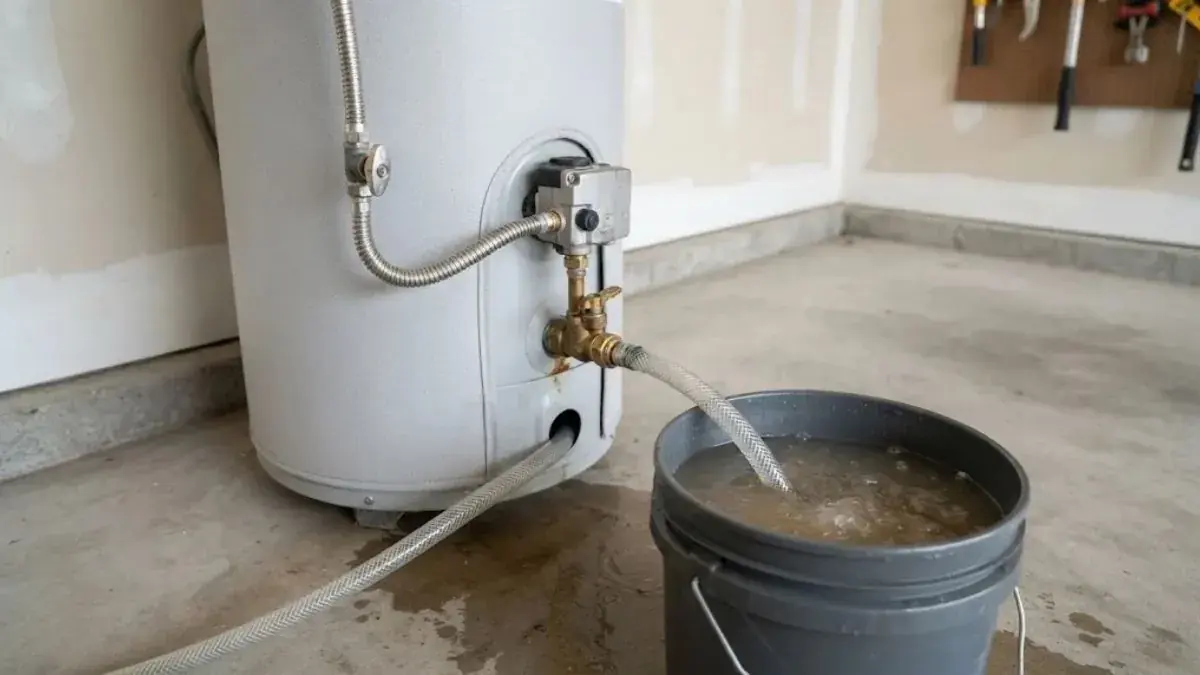
Why the filter matters
A tankless heater has narrow passages inside. Anything that gets through the supply line can lodge there. The inlet screen stops sand, pipe scale and bits of debris. After plumbing work or a water main flush, a screen can clog quickly. In moderately hard water, mineral flakes add to the load. When the screen clogs, flow drops.
The unit senses low flow and may shut off, short-cycle or show a fault. People often assume the heater is failing, when a clean screen would fix it.
How to clean it
| Step | What to do | Caution |
|---|---|---|
| Turn off the power | Switch off or unplug the unit | Never open a live unit |
| Close the cold water valve | Use the isolation valve on the inlet | Have a towel ready |
| Relieve pressure | Open a hot tap to vent | Water remains in the unit |
| Unscrew the filter | Remove the cap or housing | Do not over-tighten on return |
| Rinse the screen | Brush it under running water | Soak in vinegar if scaled |
| Reinstall and test | Open the valve, check for leaks | Restore power last |
| Some units hide the screen behind a service panel, and some have it in the inlet fitting. Check the manual for your model. If the unit has no isolation valves, stop. Valves are required for flushing and service, and a plumber can add them. |
How often to clean it
Check the screen every six to twelve months. Check it sooner after any plumbing work, a water main repair on your street or a sudden drop in flow. If grit appears every time you look, the debris source deserves attention. A whole-house sediment filter ahead of the heater protects the screen and the rest of the plumbing.
Scale inside the unit
A clean screen does not cure scale inside the heat exchanger. If flow is still weak, if you see temperature swings or if the unit reports a scale-related code, the unit probably needs a descaling flush. That means circulating a mild acid solution through the unit with a pump and then rinsing it.
Doing this once a year is a good habit in moderately hard water. Many warranties require proof of annual service, so keep the invoice.
Water facts that affect a Glendale Heights tankless heater
The Village of Glendale Heights buys Lake Michigan water through the DuPage Water Commission. The Commission's water FAQ gives the hardness as about 8 grains per gallon, or 137 mg/L as calcium carbonate, and says the water contains chlorine. The Village's 2024 water quality report states that the Village does not add chemicals to the water.
That combination means the mineral load is moderate and steady. Scale, not village treatment chemicals, is the usual cause of deposits in a tankless heat exchanger here. If you want a number for your own tap, the Village's report points residents to Public Works at (630) 260-6040.
Signs it is not the filter
If the screen is clean and flow is still low, check the shower head and aerators for scale, check that the isolation valves are fully open and look at the recirculation settings. A kinked supply line or a partly closed valve can mimic a clogged screen.
If the unit shows an error code about ignition, venting or flame, the problem is not the filter. Those codes point to gas, vent or sensor faults that a plumber should diagnose.
Protecting the unit long term
Install isolation valves if none exist. Add a sediment filter if grit is frequent. Schedule a yearly flush. Consider a water softener if scale builds quickly. Those four steps extend the life of a tankless unit far more than any single repair.
When to call a plumber
Call if you cannot find the filter, if the unit lacks isolation valves, if cleaning does not restore flow or if you see water leaking from the unit. Our tankless service covers filter cleaning, descaling and repairs, and water heater repair covers tank units.
Neighbors with the same question
Homeowners in Addison and Wheaton run into the same screen and scale issues, because their water comes through the same system and has the same moderate hardness.
Keep a service record
Write down the date of each filter cleaning and flush. A simple log helps you spot a pattern and supports a warranty claim. If the screen clogs more often over time, tell the plumber, because it may point to an issue upstream.
Tankless inlet filter questions
It sits at the cold water inlet, either behind a small cap on the fitting or inside the service panel. Check your model's manual.
Check it every six to twelve months, and after plumbing work or a drop in flow.
No. Scale inside the heat exchanger needs a descaling flush.
The Village's 2024 report says it does not add chemicals to the water it buys. Hardness is the more likely cause of scale.
Yes. They allow flushing and filter service. A plumber can add them.
Some owners do, but a plumber has the pump and solution and keeps the service record.